What I've Learned As A County Councillor
From GB News to Durham Views
When I scarped from GB News after the years I’d spent there, many assumed I’d embarked on some sort of career suicide mission. Dear reader, to a certain extent, perhaps they were right. I was making more money than I ever had before—not ITV sums, perhaps, but certainly “gobbing off on the box” sums—for the privilege of being booked to speak my mind each week.
But I grew up on a diet of worrying about the next slice of “bookability” or whatever viral scrap the London media class wanted to throw my way. I cut my teeth in Westminster while hemorrhaging cash on London rents. I’d been there since my early twenties, but I never truly felt part of the furniture growing up in an environment in which a trade meant stability. To the metropolitan elite, I was always just an accent-laden anomaly—a boy from a world they only visit when there’s a “Red Wall” focus group to conduct.
I grew up in Stanley, County Durham. During the lockdown, I dug through the archives and found that my grandmother’s ancestor, Peter Grimes, died on the very first day of the Battle of the Somme. Grimes is my grandmother’s maiden name; she’s still with us, and one day I’ll tell the story of how she saved my life. For now, just know that I carry that name with a pride they’ll never understand in the coffee shops of Islington.
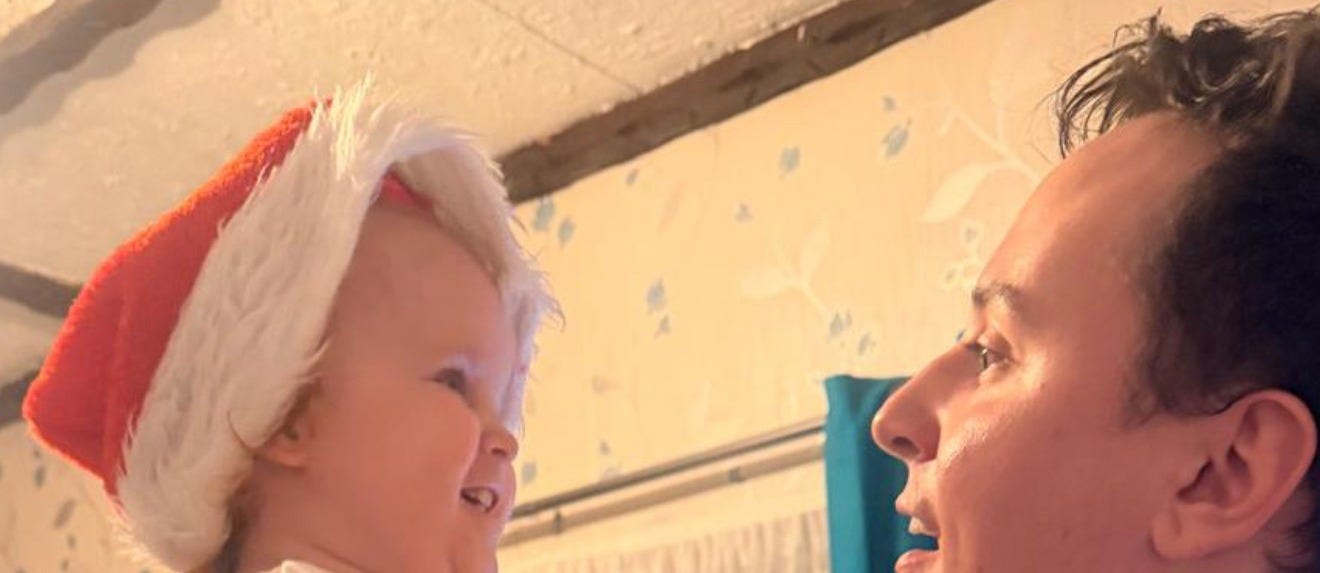
I adore her, and I adore the home my grandfather curated—stripping it back and rebuilding it from a miner’s terrace into a family home, the same home I am pictured in in the header image of this piece. That sacrifice wasn’t lost on me. I’ve spent this Boxing Day with an RAF veteran in the very same pub where my grandfather played pool every year.
That is the tradition my forebears soaked themselves in. I refuse to apologise for the life my siblings grew up in—a life where they were told their talents and fortitude amounted to nothing unless they hopped on a southbound train. My father left when I was three; I spent my life trying to ensure my youngest sibling had better outcomes than the ones “predetermined” for us. I will work, and I will never shirk, to ensure that the removal of our children to southern universities isn’t the only path to prosperity. It is a bitter pill to swallow in the face of closed industries, being told that “exit” is the only way out of County Durham.
The Blood and Iron Legacy
My grandfather didn’t just work; he sacrificed. He was part of a generation that understood duty wasn’t a “lifestyle choice” but a survival requirement. From the darkness of the mines to the freezing hills of the Korean War, he gave his sweat and his youth for the betterment of Britain. He didn’t come home to a “wellbeing retreat”; he came home to raise a five-figure family in a red-brick terrace that hummed with the quiet dignity of a man who knew his place in the world—and knew it was a place worth defending.
That is the stock we come from. The men and women who sustained the trenches and the coal seams were the very same ones who nurtured the next generation. They didn’t raise us to be “global citizens” or “displaced talent” for the London market. They raised us to be the backbone of this nation.
Starmer’s Managed Decline
Which brings us to the man currently occupying Number 10. Sir Keir Starmer views the North East not as a powerhouse of industry, but as a charity case to be managed by a bloated bureaucracy. His “New Year” offering is more of the same: a slow, grinding attrition against the Brexit we voted for, and a Net Zero obsession that exports our jobs to China while we pay the bill. He wants us dependent on the state, quiet, and grateful for the crumbs.
Today, we are told by the London-led consensus that our heritage is something to be “transitioned” away from. Starmer and his Net Zero zealots view our history as an embarrassment—a carbon footprint that needs erasing. I view my grandfather’s former mineworking past as an act of heroism. Their “Green Industrial Revolution” is a cruel joke played on towns like Stanley. It’s a scheme designed to export our heavy industry while we’re told to retrain in “digital services” or wait for a state handout. It is the managed decline of the working class, dressed up in the pious language of environmentalism.
My vision? It’s about pride-laden, heavy manufacturing. It’s about making things here again. I want the next generation to look at the mines and the factories of their forebears not as relics of a “dirty” past, but as a blueprint for a prosperous future. We owe it to the men who fought in Korea and elsewhere and dug the coal to ensure their descendants aren’t forced to beg for a life in a country they built.
Happy New Year, Sir Keir. We aren’t going anywhere.


Nice one Darren, very good read ,
Oh Kier has plans for you lot! Cannon fodder!